Mayoral election dispute continues to remain unresolved
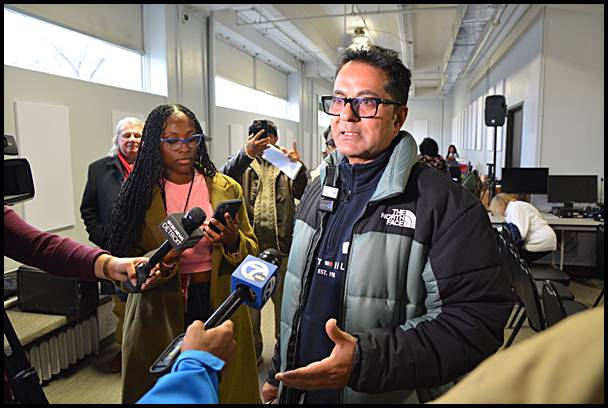
For Muhith Mahmood, his quest to win the mayoral election is not over.
By Charles Sercombe
Will Mayor Adam Alharbi’s three-month tenure in office go down as the shortest term in Hamtramck’s history?
That’s the stakes in this never-ending mayoral election, which has taken yet another twist and turn.
As most folks in Hamtramck likely know by now, there has been a running dispute over whether 37 uncounted ballots should be included in the election results from last November’s mayor and city council election.
The ballots in question were found in the city clerk’s office a day after the November election. The envelopes containing the ballots had been cut open.
Former City Clerk Rana (Faraj) Allen said she immediately contacted Wayne County election officials when she discovered the ballots, and she was told to bring them to the county.
Last week, the Michigan Court of Appeals ruled that the ballots should be counted.
The court majority ruled that not counting the ballots would violate those voters’ “fundamental right to vote,” and that, according to state law, “mistakes made by election officials must not result in the rejection of a ballot cast by an eligible voter.”
However, out of the three judges, Justice Colleen O’Brien dissented, saying the uncounted ballots, which were in opened envelopes, could have been tampered with.
At this point, Mayor Alharbi is asking the state supreme court to temporarily halt the counting of the ballots until that court hears his appeal.
It’s not known when the supreme court will rule on that appeal.
It’s also unknown what will happen if it turns out that former city councilmember Muhith Mahmood wins the mayoral election.
Alharbi won by only 11 votes, giving Mahmood a mathematical chance of overturning the election results.
According to sources, the precinct where the ballots came from is populated by mostly Bengali voters. Mahmood is a Bangladeshi-American and Alharbi is a Yemeni-American, and it’s assumed by some political observers that Mahmood would therefore have an advantage.
Mahmood praised the court ruling.
“It’s about to establish the fundamental of voter rights,” Mahmood told The Review. “It’s not about winning or losing. I appreciate the judicial system for uphold the integrity of our democracy and election process.”
Alharbi said the court of appeals erred, and that he is confident the supreme court will reverse the appeals court ruling and uphold November’s election results.
“The majority got it wrong today, but the dissenting judge got it right. We cannot afford to let those who participate in voter fraud and not live in Hamtramck win,” Alharbi said.
“The 37 ballots failed to meet the legal standard because they came out of nowhere. The court this time was divided, and we have initiated Stay of Execution to stop counting those ballots, and we are confident the supreme court will see the merit in the dissent and rule in our favor.”
Alharbi referenced accusations that some candidates here, and their supporters, ballot harvest to win elections, and that Mahmood has been accused of not being a resident.
According to an internal report conducted by a law firm hired by the city, Mahmood lives in Troy with his family.
Mahmood denies the accusation, and says he lives in a flat on Holbrook and that his family lives in Troy.
Even if Mahmood turns out to be the winner in the election, Alharbi is challenging Mahmood’s right to serve as mayor over the residency issue.
The mayoral election last November turned out to be a hot mess. Initially, Alharbi won by only six votes, but after a ballot recount performed by the Wayne County Board of Canvassers, it turned out that Alharbi actually won by 11 votes.
The county board of canvassers deadlocked on Mahmood’s demand that the 37 uncounted ballots be included in the election tally.
That tie vote, split between two Republican members and two Democratic board members, meant that the 37 ballots could not be counted, and that the election results were final.
The Republican members of the board said that, because the ballot envelopes had been opened, the ballots could have been tampered with.
Mahmood’s attorney, Mark Brewer, one of the state’s top election law attorneys, argued that, if it’s believed that the ballots were tampered with, the city could have the voters of the uncounted ballots recast their votes.
Posted April 3, 2026